
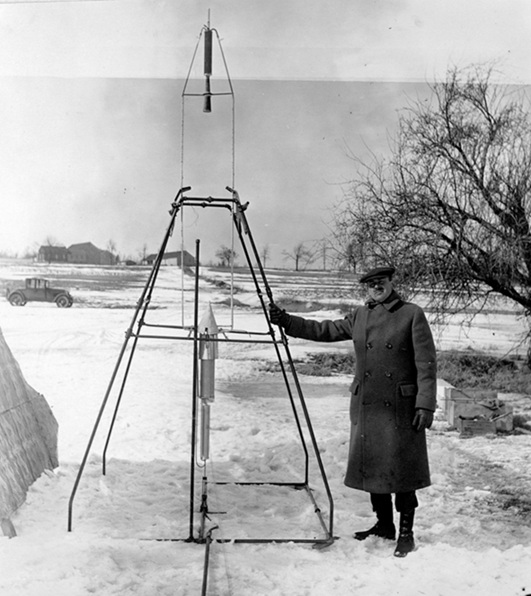
March 16, 1926: The First Liquid-Propellant Rocket Launch
Please be sure to check out our digital exhibit site on Robert Goddard, made for the world's first liquid-fuel rocket launch centennial, which took place March 16, 1926.
This series contains materials relating to the flight of March 16, 1926, in which Robert Hutchings Goddard successfully launched the world's first liquid-propellant rocket (fueled with liquid oxygen and gasoline). Goddard had been working to achieve liquid-fuel propulsion since 1921 and had written about its feasibility as far back as 1909. As described by David Clary in Rocket Man: Robert H. Goddard and the Birth of the Space Age:
"There were two major technical problems. One was that the combustion chamber would have to receive, mix, and burn the fuel and oxidizer, and exhaust the combustion gases, in an efficient manner; a chamber for solid fuels was comparatively simple. The other challenge was to find a way to feed the fuel and oxidizer into the chamber; this required pressure..."
After years of developing pumps as a means to achieve the necessary pressure, a successful static test on December 6, 1925 was conducted, resulting in the first liquid-fuel rocket to successfully operate and lift its own weight. However, Goddard observed that while the present model could lift, it would not create a successful launch at its current weight. With the pressure of producing a successful flight mounting, Goddard made a major pivot and discarded the pumps and engines in favor of a pressure-fed system. He would make something with little practical value for future innovation, but that provided the innovation he needed to produce a historic result. Many sources incorrectly claim that forgoing the pumps and engines is the breakthrough that made the December 6, 1926 lift possible, but this is untrue (the David Clary book is accurate). Goddard writes in both his diary and subsequent reports about using pumps and engines in the December 6 test, as well as the realization that he would need to eliminate them in order to produce a light enough rocket to achieve that first launch.
During this time, continued financial support could be shaky and uncertain, not to mention that LOX (liquid oxygen) was difficult to regularly obtain, store, and use. Before landing on gasoline for the choice of fuel, Goddard tried working with several different options, including ether, a gasoline-ether mixture, glycerin, and ammonium nitrate. The pressure produced from vaporized LOX (the burning process was sped up by placing cotton in a cup of alcohol under the LOX tank) pushes each liquid from its tank, through separate pipes, and into the combustion chamber for mixing and burning. These fuel lines held the rocket together. To keep the pressure even, cork floats were placed in the tanks. Interestingly, the motor resided at the top of the rocket, as Goddard initially believed having the motor upfront would improve its directional stability.
The flight took place at "Aunt Effie's" (a distant relative of Goddard's) Ward Farm in Auburn Massachusetts, where he conducted rocket experiments until 1929. Clary describes that assistant Henry Sachs "lit a blowtorch attached to a long stick, and touched off the igniter, improvised from match heads, at the top of the motor. Then he lit the alcohol tank under the LOX tank and stepped behind a propped-up wooden door for shelter. Goddard turned a valve, which let pressurized oxygen from a tank enter the fuel system, donating a boost to the vapor pressure rising from the LOX tank, heated by the alcohol flame."
As Goddard next described it, "Even though the release was pulled, the rocket did not rise at first, but the flame came out and there was a steady roar. After a number of seconds it rose, slowly until it cleared the frame, and then at express-train speed, curving over to the left, and striking the ice and snow, still going at a rapid rate. It looked almost magical as it rose, without any appreciably greater noise or flame, as if it said, 'I've been here long enough; I think I'll be going somewhere else if you don't mind'".
The delay in lift-off and very limited film length prevented Esther from capturing the flight with her new movie camera. That brief 16mm film footage can be seen here, as part of the Goddard Rocket Film Reels series. While the flight itself was not captured by photograph or video, Esther was able to record before the flight, assistant Henry Sachs igniting the rocket, and after the flight.
The delay was due to the rocket needing to burn off excess fuel before it could lift off.The rocket's altitude was 41 feet at an average of 60 miles per hour; it was in the air for 2.5 seconds and landed 184 feet from the launching frame, traveling a total path of 220 feet.
In his "Report on the Development of Liquid Propelled Rocket", Goddard provided photographs of every newly developed part and/or component; he did not take photographs of every minor adjustment or iteration made (for example the many variances of width, diameter, thickness and length of various materials). Every photograph of a rocket component aligning with the March 16, 1926 launch has been included in this series. This is the first time photographs of these rocket parts have been made available for online viewing, and together they make up the closest and most granular visual documentation of the March 16, 1926 rocket's construction that there is.
All collection descriptions written by Katie Stebbins, Digital Projects Librarian.
Submissions from 1971
Aerial photograph of March 16, 1926 testing site, circa late 1960s-early 1970s, Edward A. Cournoyer
Submissions from 1927
Material for An Autobiography [excerpt], 1927, Robert H. Goddard
Submissions from 1926
Robert Goddard's diary entry, March 17, 1926, Robert H. Goddard
[020] Testing frame and wind break at Ward Farm, Auburn, Mass., March 1926, Esther C. Goddard
[021] Liquid oxygen-gasoline rocket in the frame from which it was fired in Auburn, Massachusetts on March 16, 1926, Esther C. Goddard
[022] Assistant (Henry Sachs) igniting the rocket, March 16, 1926, Esther C. Goddard
[023] "The empty frame" after world's first flight of a liquid-propelled rocket, March 16, 1926, Esther C. Goddard
[024] Henry Sachs, Robert Goddard, and Percy Roope with parts of first liquid-propellant rocket after flight, March 16 1926, Esther C. Goddard
Figure 123: Rocket in testing frame at Ward Farm, March 6, 1926, Esther Goddard
Figure 125: Rocket in testing frame at Ward Farm, March 16, 1926, Esther Goddard
Figure 126: Robert Goddard standing next to rocket at Ward Farm, March 16, 1926, Esther Goddard
Figure 128: Henry Sachs, Percy Roope, and Esther Goddard with parts of first liquid-propellant rocket after flight, March 16 1926, Robert H. Goddard
Figure 129: Robert Goddard with parts of first liquid-propellant rocket after flight, March 16 1926, Esther Goddard
Figure 130: Rocket parts after landing, March 16, 1926, Esther H. Goddard
[019] Rocket ready for outdoor test, March 1926, Esther C. Goddard
Figure 110: Assembled liquid oxygen tank [2], March 1926, Esther C. Goddard
Figure 111: Assembled liquid oxygen tank [3], March 1926, Esther C. Goddard
Figure 112: Dismantled liquid oxygen tank, March 1926, Esther C. Goddard
Figure 113: Dismantled liquid oxygen tank [2], March 1926, Esther C. Goddard
Figure 114: Gasoline tank, March 1926, Esther C. Goddard
Figure 115: Disassembled gasoline tank [March 1926], Esther C. Goddard
Figure 116: Robert Goddard with completed rocket in testing frame, March 1926, Esther C. Goddard
Figure 117: Completed rocket in testing frame, March 1926, Esther C. Goddard
Figure 118: Robert Goddard with completed rocket in testing frame, March 1926 [2], Esther C. Goddard
Figure 119: Robert Goddard with completed rocket in testing frame, March 1926 [3], Esther C. Goddard
Figure 120: Robert Goddard with completed rocket in testing frame, March 1926 [4], Esther C. Goddard
[018] Two tanks for pressure-operated rocket, Winter 1926, Esther C. Goddard
Development of a liquid propelled rocket, section III: December 1925 - May 1926 [excerpt], Robert H. Goddard
Figure 102: Two tanks for pressure-operated rocket, Winter 1926, Esther C. Goddard
Figure 103: Disassembled liquid oxygen tank, Winter 1926, Esther C. Goddard
Figure 104: Entrance pipes for liquid fuels, Winter 1926, Esther C. Goddard
Figure 105: Entrance pipes for liquid fuels [2], Winter 1926, Esther C. Goddard
Figure 106: Combustion chamber and nozzle, Winter 1926, Esther C. Goddard
Figure 107: Combustion chamber and nozzle [2], Winter 1926, Esther C. Goddard
Figure 108: Combustion chamber and nozzle [3], Winter 1926, Esther C. Goddard
Figure 109: Assembled liquid oxygen tank, March 1926], Esther C. Goddard
Reel 01: Tests of Liquid-Propellant Rockets by Dr. Robert H. Goddard, at Auburn Mass., 1926-1928, Esther C. Goddard and Robert H. Goddard
Robert Goddard's 1926 Diary, Robert H. Goddard