

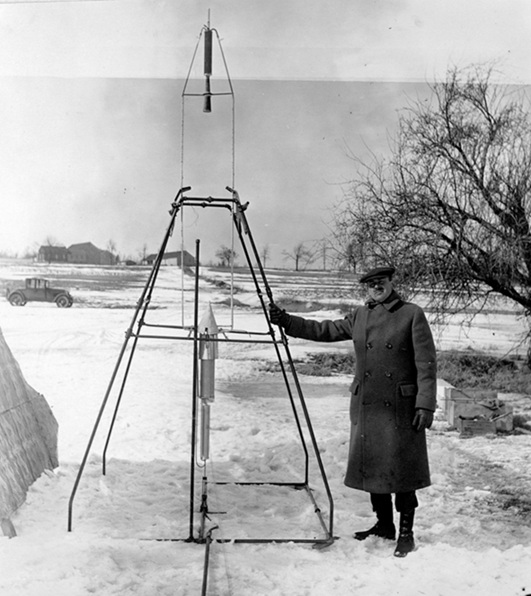
March 16, 1926: The First Liquid-Propellant Rocket Launch
Document Type
Photograph
Date
3-16-1926
Keywords
Robert Goddard, rocketry, liquid-propellant rocket
Description
Photograph of Robert Goddard's assistant Henry Sachs (left), former student and fellow Clark University Physics professor Percy Roope (middle), and wife Esther Goddard who photographed and filmed much of her husband's work. They stand with parts from the rocket following the test of March 16, 1926 at Aunt Effie's (a distant relative of Goddard) Ward Farm in Auburn, Massachusetts. This test marked the world's first successful launch of a liquid-propelled rocket.
In his book Rocket Man: Robert H. Goddard and the Birth of the Space Age, David Clary describes that assistant Henry Sachs "lit a blowtorch attached to a long stick, and touched off the igniter, improvised from match heads, at the top of the motor. Then he lit the alcohol tank under the LOX tank, and stepped behind a propped-up wooden door for shelter. Goddard turned a valve, which let pressurized oxygen from a tank enter the fuel system, donating a boost to the vapor pressure rising from the LOX tank, heated by the alcohol flame."
As Goddard next described it, "Even though the release was pulled, the rocket did not rise at first, but the flame came out and there was a steady roar. After a number of seconds it rose, slowly until it cleared the frame, and then at express-train speed, curving over to the left, and striking the ice and snow, still going at a rapid rate. It looked almost magical as it rose, without any appreciably greater noise or flame, as if it said, 'I've been here long enough; I think I'll be going somewhere else if you don't mind'".
The delay in lift-off and very limited film length prevented Esther from capturing the flight with her new movie camera. That brief 16mm film footage can be seen here, as part of the Goddard Rocket Film Reels series. While the flight itself was not captured by photograph or video, Esther was able to record before the flight, assistant Henry Sachs igniting the rocket, and after the flight.
The delay was due to the rocket needing to burn off excess fuel before it could lift off.
The rocket's altitude was 41 feet at an average of 60 miles per hour; it was in the air for 2.5 seconds and landed 184 feet from the launching frame, traveling a total path of 220 feet.
This photograph was used in Goddard's "Report on the Development of a Liquid Propelled Rocket". This is the first time many of these photographs have been made available for online viewing, and together they represent the most granular visual documentation of the March 16, 1926 rocket and its leadup in existence. An excerpt of that report covering everything between December 6, 1926 and March 16, 1926 can be found here.
Photographs were scanned at 400dpi.
Rights and Permissions
These images are the property of Clark University and are intended for non-commercial use. Images may be copied for research, teaching, personal, or any fair use as defined by U.S. copyright law. Images may not be altered in any way. Users of these images are asked to acknowledge Clark University. For questions or further information about usage rights, please contact [email protected].
Recommended Citation
Goddard, Robert H., "Figure 128: Henry Sachs, Percy Roope, and Esther Goddard with parts of first liquid-propellant rocket after flight, March 16 1926" (1926). March 16, 1926: The First Liquid-Propellant Rocket Launch. 24.
https://commons.clarku.edu/goddardlaunch/24

Comments