
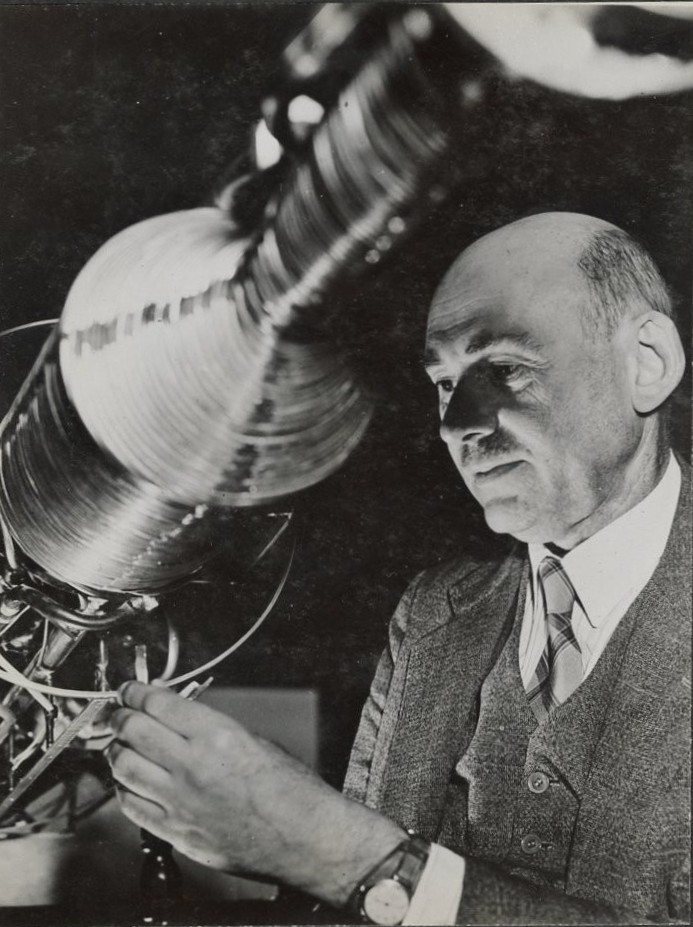
The Robert & Esther Goddard Collection
Please be sure to check out our digital exhibit site on Robert Goddard, made for the world's first liquid-fuel rocket launch centennial, which took place March 16, 1926.
In honor of the upcoming centennial of Robert H. Goddard's first successful liquid-fueled rocket launch, which took place in Auburn, Massachusetts on March 16, 1926, Clark University's Archives & Special Collections has digitized highlights from two of our biggest and most notable collections: The Robert & Esther Goddard Papers.
Robert Goddard is America's founding father of modern rocketry, achieving the world's first launch of a liquid-fuel rocket. He was also the first to provide experimental proof that rockets could provide thrust in a vacuum. He spent his life working on and experimenting with various aspects of rocket development, refining and testing such variables as gyroscopic stabilization, regenerative cooling of combustion chambers, instrumented payloads and recovery systems, and more.
Robert Goddard grew up in Worcester and was a two-time alumnus of Clark University. After earning his undergraduate degree at WPI, he received his master’s degree in 1910 and his Ph.D. in 1911 from Clark and served as a professor in Clark’s Physics Department for 29 years. Goddard conducted his pioneering rocketry research in laboratories at Clark.
As a boy, Goddard was reserved and very prone to illness. He grew up being inspired by the early science fiction of Jules Verne and H.G. Wells. That inspiration became an epiphany one October day in 1899 when, after climbing a cherry tree in his yard to trim the limbs, Goddard looked up at the sky and (in his words) "imagined how wonderful it would be to make some device which had even the possibility of ascending to Mars". From then on, he dedicated his life to exploring the possibilities of space travel. At this time, space exploration only existed in the realms of fiction, but his work was crucial in making it reality.
Esther Goddard proudly dedicated herself to her husband's work and their life together. They were truly a team. She managed all aspects of their lives, and acted as his typist, bookkeeper, and business manager. Her interest in photography led her to photograph and film (Robert gave her a 16mm movie camera in 1926) his work including equipment, workspaces, static and flight tests, and more.
Following Robert's death in 1945, Esther devoted the rest of her life (she died in 1982) to building and promoting the legend, reputation, and importance of Robert’s life and work. These papers, meaning their organization and annotations, are just one result of these efforts. With the help of the Guggenheim Foundation, who funded Robert's research for many years, Esther reclaimed all of her husband's patents (214 in total, most of which had not been in his name), even winning a lawsuit against the US government for patent infringement. She also transcribed, copied, and annotated their materials, gave speeches, conducted outreach, edited and published a three-volume set of his work, facilitated exhibits, dedications, and memorials, and successfully campaigned for posthumous awards and medals. Her careful curation adds yet another fascinating layer to this collection.
The repository features some collection highlights including:
- Materials relating to the historic March 16, 1926 launch
- Film Reels shot by Esther Goddard
- An annotated photo album documenting Robert's work
- The Papers of Robert H. Goddard, the 3-volume set co-edited by Esther
- Editorial cartoons and illustrations regarding Goddard from the early 1920s
We will be adding additional materials throughout 2026, including photographs of various artifacts.
Sources consulted for the descriptions in this collection include The Papers of Robert Goddard, Rocket Man: Robert H. Goddard, the Birth of the Space Age by David Clary, and This High Man: The Life of Robert Goddard by Milton Lehman.
Robert Goddard collection descriptions written by Katie Stebbins, Digital Projects Librarian.
Browse The Robert & Esther Goddard Collection:
Goddard in the Press: Editorial Cartoons and Illustrations (1920-1925)
Goddard's Students & Colleagues
March 16, 1926: The First Liquid-Propellant Rocket Launch