

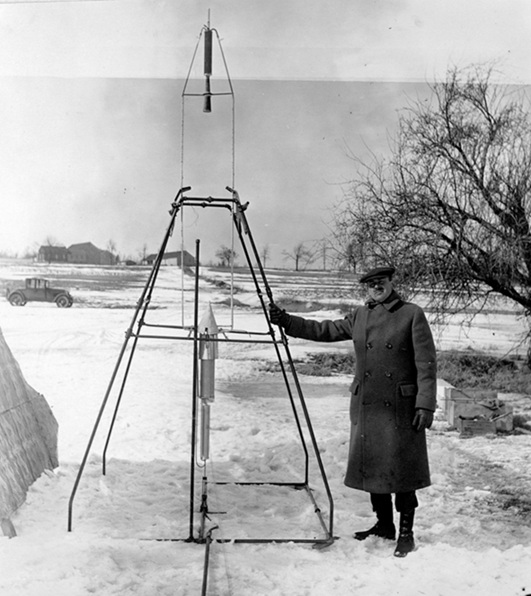
March 16, 1926: The First Liquid-Propellant Rocket Launch
Document Type
Photograph
Date
3-1926
Keywords
Robert Goddard, rocketry, liquid-propellant rocket
Description
Photograph of the completed rocket in its testing frame. This was taken at Clark University before the tests of March 5, 1926 and March 16, 1926, the latter of which marked the world's first launch of a liquid-propellant rocket. This photograph shows the rocket covered with thin sheet aluminum (for photographs of the various rocket parts lying underneath the aluminum, check out the other photographs of this series. Underneath the cone at the top is a silk parachute fastened to the aluminum. Neither the cone covering or the parachute were ultimately used in the tests.
Following December 6, 1925 (the day Goddard achieved the first liquid-fuel rocket to lift its own weight), he realized a successful launch required making the rocket as streamlined and light as possible. Despite working for years to develop pumps and engines for rockets, he would now be relying on the pressure of oxygen evaporated within a liquid oxygen tank.
It is important to note that many sources incorrectly claim that forgoing the pumps and engines is the breakthrough that made the December 6 lift possible, but this is untrue. Goddard writes in both his diary and subsequent reports about using pumps and engines in the December 6 test, as well as the realization that he would need to eliminate them in order to produce a light enough rocket to achieve that first launch.
This photograph was used in Goddard's "Report on the Development of a Liquid Propelled Rocket". This is the first time many of these photographs have been made available for online viewing, and together they represent the most granular visual documentation of the March 16, 1926 rocket and its leadup in existence. An excerpt of that report covering everything between December 6, 1926 and March 16, 1926 can be found here.
Photographs were scanned at 400dpi.
Rights and Permissions
These images are the property of Clark University and are intended for non-commercial use. Images may be copied for research, teaching, personal, or any fair use as defined by U.S. copyright law. Images may not be altered in any way. Users of these images are asked to acknowledge Clark University. For questions or further information about usage rights, please contact [email protected].
Recommended Citation
Goddard, Esther C., "Figure 117: Completed rocket in testing frame, March 1926" (1926). March 16, 1926: The First Liquid-Propellant Rocket Launch. 20.
https://commons.clarku.edu/goddardlaunch/20

Comments