
Goddard in the Press: Editorial Cartoons and Illustrations (1920-1925)
Preview
Description
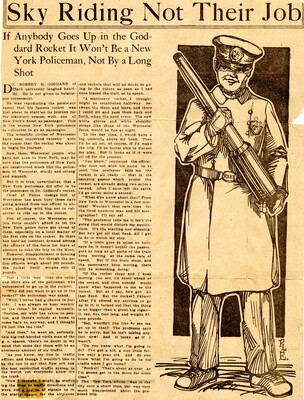
An illustration of a New York City cop accompanying an article titled "Sky Riding Not Their Job", from the December 28, 1924 edition of the Worcester Telegram. This concerns another New York City policeman who publicly volunteered to be a passenger on the "moon rocket" that Robert Goddard was reported to be making headway on. These volunteers were volunteering based off of entirely sensationalized news stories involving Goddard's work. One part of the article states that "Chief of Police George Hill of Worcester, has been busy these days going around from one officer to another. pleading with him not to volunteer to ride up in his rocket". The illustrator could not be confirmed, but their initials are likely P.L.E, as signed on the bottom right.
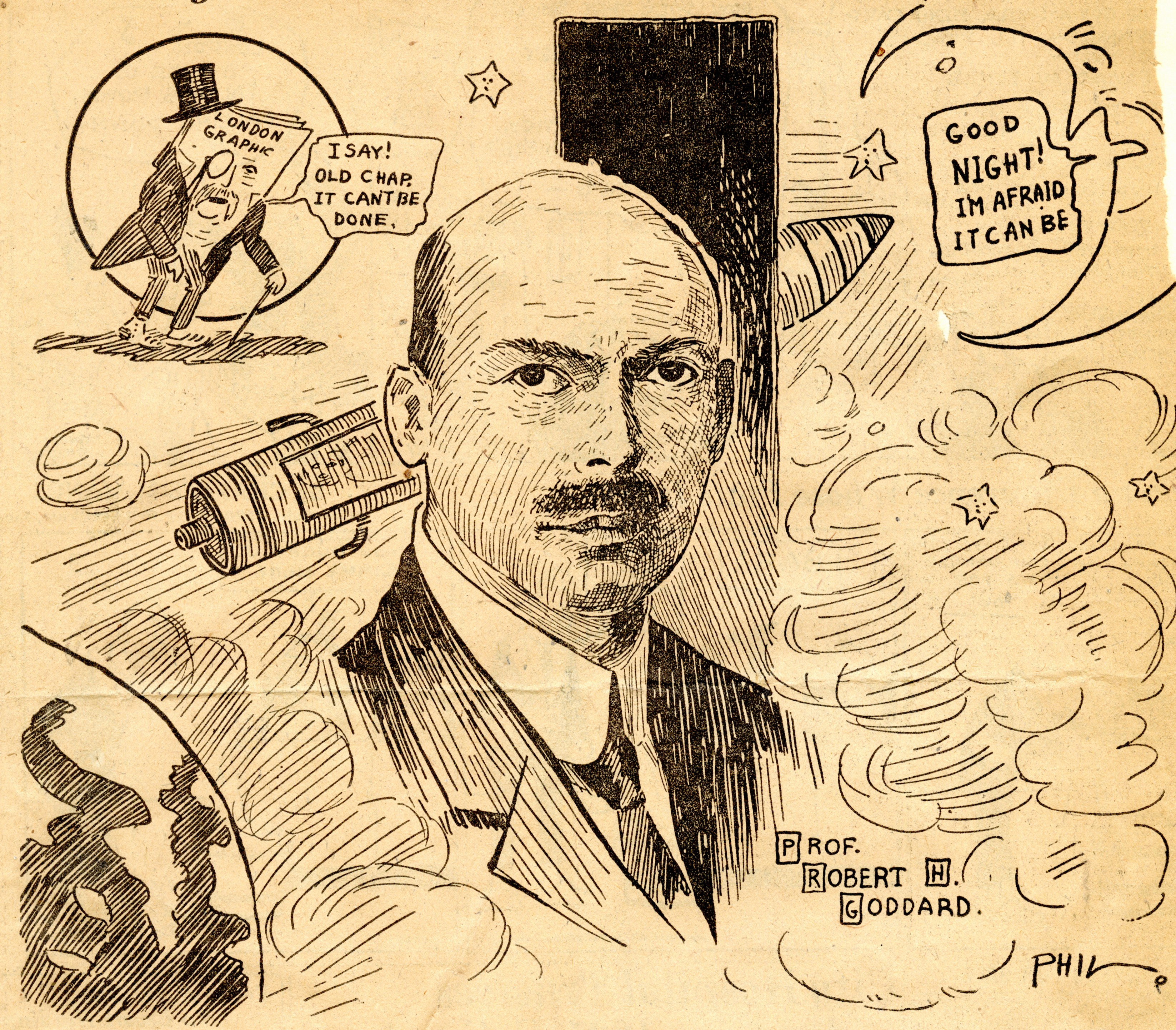
"Goddard in the Press: Editorial Cartoons and Illustrations" collects editorial cartoons and illustrations that appeared alongside early print coverage of Robert Goddard. The scope is limited to everything within the public domain (up through 1929 at the time of this writing). From papers of record to local newspapers, the initial reportage around Goddard was largely a circus of groundless sensationalism.
Robert Goddard’s introduction as a public figure came soon after December of 1919, when Smithsonian Miscellaneous Collections published his paper “A Method of Reaching Extreme Altitudes”. Detailing years of vacuum experiments, it provided the first published mathematical proof that solid-propellant rockets (he would not switch to liquid fuel until 1921) were capable of reaching beyond Earth’s atmosphere. The Smithsonian then, unconventionally, gave a press release for ‘Extreme Altitudes’ to announce Goddard’s findings. Goddard only mentions the Moon near the end of his nearly eighty-page paper. In a brief piece of extraneous speculation, he considers the challenge in acquiring proof of extreme altitudes, suggesting a mass of flash powder be sent to the Moon to ignite on impact. The flash of this ‘flash powder’ scenario proved too enticing to the Smithsonian publicist, who ended the press release by stating “the possibility of sending to the surface of the dark part of the Moon a sufficient amount of the most brilliant flash powder…. its successful trial would be of great general interest as the first actual contact between one planet and another”. Journalists saw ‘rocket’ and ‘Moon’ in the press release, and the media firestorm began.
Collected together, this series provides insight into Goddard as a public figure, the kinds of strategies and misinformed angles that can drive news cycles. News coverage of Goddard’s “Moon rocket” was worldwide, seeding Jules Verne’s visions of spaceflight into the realm of possibility for the public. The fantasy of Goddard’s ‘Moon rocket’ went on to ignite imaginations the worldwide over in the same way Verne’s fantasies had for Goddard himself.
Socio-culturally, it was a major contributor to the space craze of the 1920s, particularly in the United States, Germany, and post-revolutionary Russia. Not coincidentally, Hermann Oberth and Konstantin Tsiolkovoskii, along with Goddard, make up the ‘fathers of modern rocketry’ trifecta. These countries were already taken with space exploration, but the 1920s began to fuse space travel and national identity in ways that shaped 20th century history.
Goddard received almost no press at the time of his most famous achievement, successfully launching the world’s first liquid-propellant rocket on March 16, 1926.
Some of these illustrations reflect the time period in which they were written, may include outdated or offensive terminology and/or caricatures.
Photographs were scanned at 400dpi.
Date
12-28-1924
Type
image
Genre
illustration
Format
jpg
Keywords
Robert Goddard, press, newspapers, editorial cartoons, illustrations, Moon, rockets
Recommended Citation
Unknown, ""Sky Riding Not Their Job", Worcester Telegram" (1924). Goddard in the Press: Editorial Cartoons and Illustrations (1920-1925). 44.
https://commons.clarku.edu/goddardcartoons/44
Keywords
Robert Goddard, press, newspapers, editorial cartoons, illustrations, Moon, rockets