
The Goddard Rocket Film Reels
Type
Video
Loading...
Date
1935-1936
Description
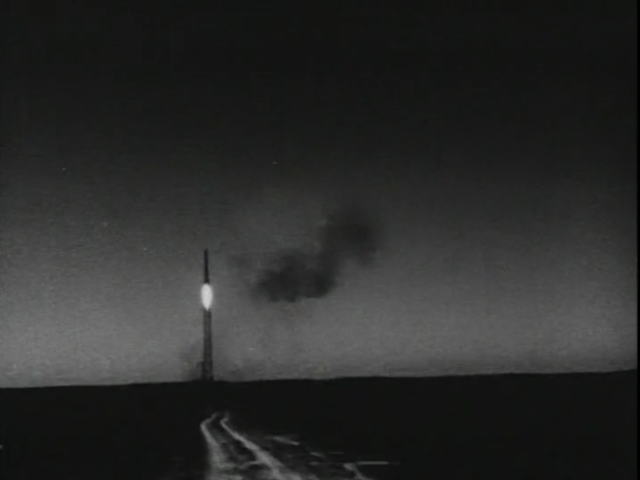
The Goddard Rocket Film Reels consists of twelve four-hundred-foot 16mm black-and-white film reels documenting Robert Goddard's experimental work with rockets in Auburn, Massachusetts, Roswell, New Mexico, and Annapolis, Maryland from 1926 through 1945. These reels were restruck in the mid-1960s, which were then digitized several years ago. Some, and very likely all, of these home movies were shot by Robert's wife Esther C. Goddard.
Reel 7 consists of rocket experiments during Robert and Esther Goddard's second move to Roswell, New Mexico which lasted from 1934 to 1942. The first section, Static Tests of Large Rocket Chamber - November 22, 1935 to February 12, 1936, cover the process for carrying out the 'K' Series of tests. The second section, Series of Ten Static Tests, November 22, 1935 to February 12, 1936 (K Series) shows the 'K' series of tests. These were a series of ten proving-stand tests for the development of a more powerful motor, 10 inches in diameter. The last section features Dr. Goddard himself demonstrating the steering gyroscope principle.
This list of intertitles gives a detailed account of the footage contained in this reel:
Static Tests of Large Rocket Chamber - November 22, 1935 to February 12, 1936
(00:09) The lift, pressures, temperatures, rates of flow, and time are recorded photographically at the dugout
(00:24) In preparing for a test, the rocket is placed in the tower, using a block and tackle
(01:24) The pipe line for the lift pressure gauge is filled with fluid...
(01:51) The electric cable from tower to dugout is unrolled...
(02:07) The electrical connections are made...
(02:30) A water jacket around the nozzle is filled...
(02:48) Thermocouples are placed on the chamber and in the water jacket
(03:00) In carrying out a test, a stop watch is started, the switches closed, and the caps removed from the camera
(03:20) Two observers then go to the 140-foot shelter
(03:31) Two others operate the rocket from the 1000-foot shelter
Series of Ten Static Tests, November 22, 1935 to February 12, 1936 (K Series)
(04:01) K1
(04:11) K2
(04:15) K3
(04:31) K4
(04:41) K5
(04:49) K6
(04:55) K8
(05:11) K9
(05:29) K10
(06:14) Closeup of a static test
(06:19) K7
Demonstration of a Steering Gyroscope
(06:44) When the gyro is spinning, a small tilt produces a small speed of rotation...
(06:53) ...and large tilt produces a large speed of rotation
(07:00) ...further, a gradually increasing tilt produces a gradually increasing rotation...
(07:17) Tilting the gyro in opposite direction reverses the direction
(07:36) Turning can be stopped at any point, and the stopping is completely “dead beat”, no matter how fast the operation takes place
(07:52) A rotation may be stopped by tilting the gyroscope...
(08:02) ...and restored by bringing back the gyroscope axis to horizontal
(08:15) Turning by an outside force can be stopped and return to initial position
(08:40) Notice that the gyro tilt is reversed when half the return has been covered
(08:56) Notice also that there is a residual tilt of a gyro, which depends on the amount of the outside force
(09:22) Notice that restoration of position takes place in two steps
(09:32) The first step is to stop the rotation produced by the outside force
(09:40) The second step is to turn back to the original position
(09:48) These two steps normally in succession
(10:00) With a rapidly spinning gyro, any angular position may be had, with speed of rotation, regardless of outside forces
Duration
00:11:19
Genre
home movies
Keywords
Robert H. Goddard, rocketry, home movies, motion picture film, gyroscopes
Recommended Citation
Goddard, Esther C. and Goddard, Robert H., "Reel 07: Static Tests of Large Rocket Chamber; Series of Ten Static Tests Video (K Series), - November 22, 1935 to February 12, 1936; Demonstration of a Steering Gyroscope" (1936). The Goddard Rocket Film Reels. 6.
https://commons.clarku.edu/goddardfilm/6