
The Goddard Rocket Film Reels
Type
Video
Loading...
Date
1928-1930
Description
The Goddard Rocket Film Reels consists of twelve four-hundred-foot 16mm black-and-white film reels documenting Robert Goddard's experimental work with rockets in Auburn, Massachusetts, Roswell, New Mexico, and Annapolis, Maryland from 1926 through 1945. These reels were restruck in the mid-1960s, which were then digitized several years ago. Some, and very likely all, of these home movies were shot by Robert's wife Esther C. Goddard.
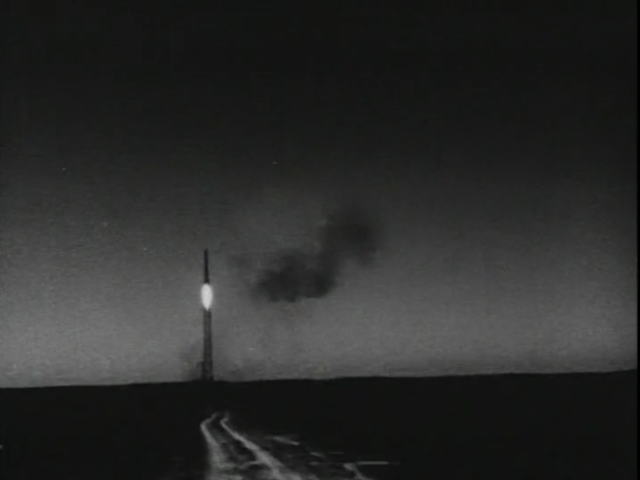
Reel 2 depicts a continuation of tests of liquid-propellant rockets by Dr. Robert H. Goddard, at Auburn and Camp Devens, Massachusetts from 1928 to 1930. Highlights include the third and fourth flights of a liquid-propellant rocket on December 26, 1928 and July 17, 1929 respectively.
The latter test, in which the gasoline tank exploded, could be heard by neighbors two miles away. It garnered local and then national news headlines, causing Goddard to release a statement to the press. While the district fire inspector deemed the testing site to be safe and in a clear area, his flight tests were then banned in Massachusetts by the State Fire Marshall. Goddard would then move his testing out of reach from the State Fire Marshall to federal ground at Camp Devens, an army post northwest of Worcester.
This list of intertitles gives a detailed account of the footage contained in this reel:
(00:08) Tests in the spring of 1928. Occasionally rocket was released when lift exceeded its weight, but the thrust was not quite sufficient to send it out of the launching tower.
(03:04) Tests in the summer of 1928. Combustion was gradually being improved
(05:44) Fall of 1928, test of new design with combustion chamber and nozzle once again at the top of the rocket, with the gasoline tank, and with two liquid oxygen tanks some distance below, at sides. This model was called by Dr. Goddard the “hoopskirt” model.
(06:03) Test of October 20, 1928, when the hoopskirt model became caught in the launching tower as it rose
(06:36) Test of December 26, 1928, when the rocket left the tower, with the ensuing grass fire
Regarding the Test of December 26, 1928, from Milestones in the Rocket Experiments of R.H. Goddard, 1915-1945 in volume 3 of The Papers of Robert H. Goddard: "Rose out of tower rapidly and tipped, passing over observation shelter; distance 204.5 ft; speed about 60mph. This flight was followed by a series of static tests, to develop liquid "curtain cooling" for inside of combustion-chamber wall, a regenerative system, and better stability in flight."
(07:32) Test of May 17, 1929, with new 60-foot launching tower and shelter
(08:12) Test of May 23, 1929, when rocket rose about 10 feet in the tower, and then dropped back
(08:57) Static test of May 25, 1929
(09:14) Test of July 8, 1929, with recording instruments on the rocket for the first time. A barometer, thermometer, and moving picture camera were used
(09:41) Flight of July 17, 1929, which attracted the attention of the neighborhood, and resulted in widespread publicity. Movies of actual flight were removed to make still pictures for publication
Regarding the Test of July 17, 1929, from Milestones in the Rocket Experiments of R.H. Goddard, 1915-1945 in volume 3 of The Papers of Robert H. Goddard: "Length 11ft 6 in.; maximum diameter 32 lb; gasoline 14lb; liquid oxygen 11lb; total loaded weight 57 lb. Started to lift at 13 sec; rose at 14 1/2 sec; landed 171ft from tower. Flight was bright and noisy, attracted public attention."
(10:10) Tests of powder rockets, using one post of the launching tower
(10:57) Tests at new launching site at artillery range at Camp Devens, Mass., winter and spring 1929-1930
Duration
00:12:04
Genre
home movies
Keywords
Robert H. Goddard, rocketry, home movies, motion picture film, liquid-propellant rockets
Recommended Citation
Goddard, Esther C. and Goddard, Robert H., "Reel 02: Continuation of Tests of Liquid-Propellant Rockets by Dr. Robert H. Goddard, at Auburn and Camp Devens, Mass., 1928-1930" (1928). The Goddard Rocket Film Reels. 2.
https://commons.clarku.edu/goddardfilm/2