
![The Goddard Rocket Researches: A Photographic Record [Individual Photographs]](../../assets/md5images/5563c8f0ce3ad094e6aae9409d220fb9.jpg)
The Goddard Rocket Researches: A Photographic Record [Individual Photographs]
Preview
Description
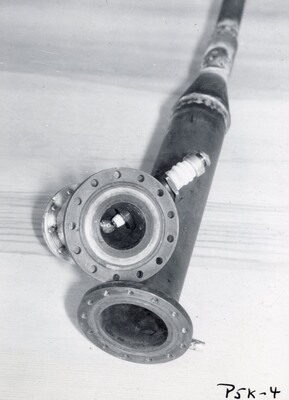
Photograph of a "small chamber to evaporate and warm sufficient oxygen to operate two pump turbines using gasoline and oxygen, April 25, 1939" (annotation by Esther Goddard). Goddard spent March 24 through April 18th of that year developing a gas generator for the P-Series of tests. This gas generator was developed through a subseries of tests called P5a-k.
By 1938, Robert Goddard felt he had covered everything needed for successful high-flying rockets -- except for a turbine that could drive high-speed pumps to force propellants into the chamber. This would define his work over the next several years. The P-Series of tests Goddard would conduct took place from January 1939 into October of 1941.
P1-P4 used two pump models that had been tested during the preceding months to conduct four proving-stand tests. The results from P1-P4 concluded that a small chamber, or gas generator, producing warm oxygen gas should be developed for a successful turbine. The development of this gas generator would make up tests P5-P12. Goddard would refer to this gas generator as "an internal combustion-boiler for liquid oxygen", "the object of which was to convert liquid oxygen into warm gaseous oxygen, in a device of small size and light weight, by the combustion of gasoline within this liquid oxygen". This warm gas is what would drive the turbines. From there, flight and static tests using liquid-propellant rockets with these high-speed centrifugal turbine-driven pumps were conducted for tests P13-P36. These rockets averaged nearly 22 feet in length and were 18 inches in diameter. Empty, they weighed between 190 to 240 pounds. The liquid-oxygen load averaged about 140 pounds and the gasoline 112 pounds, making these "quarter-ton" loaded rockets.
Ultimately, the P-Series would expose the unsustainability of Goddard’s objectives working with large and more complex turbine rockets. Combined with his longtime aversion towards scientific collaboration, and a counterintuitive approach to testing that often emphasized changing several variables at a time, the P-Series saw him biting off more than he could chew. The P-Series of tests can be seen in Reel 9 and Reel 10 of The Goddard Rocket Film Reels.
'The Goddard Rocket Researches: A Photographic Record' is an annotated photo album covering Robert H. Goddard's work and experimentation with rocketry. It was assembled and curated by Esther Goddard sometime after her husband's passing in 1945. Additionally, almost all of the photographs were taken by Esther herself.
Photographs were scanned at 400dpi.
Date Taken
4-1939
Type
image
Genre
photograph
Format
jpg
Keywords
Robert Goddard, rocketry, rockets, Roswell, New Mexico, liquid-fuel rockets, nitrogen, pump-fed rockets, turbines, gas generator, turbopumps
Recommended Citation
Goddard, Esther C., "[243] Small chamber to evaporate and warm sufficient oxygen to operate two pump turbines using gasoline and oxygen, April 26 1939" (1939). The Goddard Rocket Researches: A Photographic Record [Individual Photographs]. 242.
https://commons.clarku.edu/goddardphotographs/242
Rights
This image is the property of Clark University and is intended for non-commercial use. Images may be copied for research, teaching, personal, or any fair use as defined by U.S. copyright law. Images may not be altered in any way. Users of these images are asked to acknowledge Clark University. For questions or further information about usage rights, please contact [email protected]
Keywords
Robert Goddard, rocketry, rockets, Roswell, New Mexico, liquid-fuel rockets, nitrogen, pump-fed rockets, turbines, gas generator, turbopumps