
![The Goddard Rocket Researches: A Photographic Record [Individual Photographs]](../../assets/md5images/5563c8f0ce3ad094e6aae9409d220fb9.jpg)
The Goddard Rocket Researches: A Photographic Record [Individual Photographs]
Preview
Description
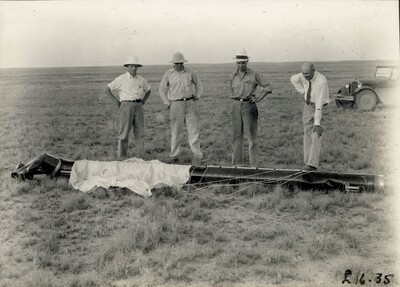
Photograph of Robert Goddard (right) alongside staff members looking down at the "gimbal-steered rocket after flight of July 28, 1937. Parachute usually draped itself over rocket in this fashion" (annotation by Esther Goddard). The flight test of July 28, 1937 was L16 in Robert Goddard's L-Series of tests. This rocket (which was also in good enough condition to be used for L17) was a movable casing rocket; it featured a movable-tailpiece, or gyro-controlled gimbal steering, wire-wound tanks, and a barometric switch controlling the parachute. The rocket weighed 162 pounds fully loaded. The flight lasted 28 seconds and reached an altitude of 2055 feet.
Between May 11, 1936 and August 9, 1838, Robert Goddard conducted the L-Series of tests in Roswell, New Mexico. Goddard and his wife Esther lived in Roswell from 1930 to 1932 and 1934 to 1942 as a result of Guggenheim-funded grants, allowing Goddard to conduct his research and experiments with rocketry. The L-Series consisted of thirty flight tests divided into three sections (A; L1-L7; B; L8-L15; C; L16-L30) testing ten-inch diameter motors in nitrogen-pressured rockets. Seventeen of these tests were flights tests, while the other thirteen were static tests. The L-Series tackled a range of variables and challenges that came with building larger rockets. Reel 8 of The Goddard Rocket Film Reels contains 22 minutes of footage from the 'L' tests.
The missiles constructed for this L-Series started out shorter and heftier (at about eighteen inches in diameter) and grew longer and leaner over the course of the tests. By L7, Goddard switched from one larger motor to four smaller combustion chambers. The consistent problem preventing high altitude flights was the burning of combustion chambers. Goddard steered away from methods of regenerative cooling that had been developed and stuck to curtain cooling. Goddard and his team, not to mention the Guggenheim Foundation funding him, would have to wait until L13 to achieve another high-flying rocket.
'The Goddard Rocket Researches: A Photographic Record' is an annotated photo album covering Robert H. Goddard's work and experimentation with rocketry. It was assembled and curated by Esther Goddard sometime after her husband's passing in 1945. Additionally, almost all of the photographs were taken by Esther herself.
Photographs were scanned at 400dpi.
Date Taken
7-28-1937
Type
image
Genre
photograph
Format
jpg
Keywords
Robert Goddard, rocketry, Roswell, New Mexico, liquid-fuel rockets, rocket motors, nitrogen, pressure-fed rockets, movable casing rocket
Recommended Citation
Goddard, Esther C., "[183] Gimbal-steered rocket after flight of July 28 1937" (1937). The Goddard Rocket Researches: A Photographic Record [Individual Photographs]. 184.
https://commons.clarku.edu/goddardphotographs/184
Rights
This image is the property of Clark University and is intended for non-commercial use. Images may be copied for research, teaching, personal, or any fair use as defined by U.S. copyright law. Images may not be altered in any way. Users of these images are asked to acknowledge Clark University. For questions or further information about usage rights, please contact [email protected].
Keywords
Robert Goddard, rocketry, Roswell, New Mexico, liquid-fuel rockets, rocket motors, nitrogen, pressure-fed rockets, movable casing rocket