Hanford Action of Oregon
The Hanford Action of Oregon is one of 39 environmental and peace organizations that won a landmark lawsuit against the U.S Department of Energy for failure to follow-through on adequate environmental cleanup during its 50+ years of nuclear weapons research, testing, and production. Part of this settlement was the establishment of the MTA Fund (Citizens’ Monitoring and Technical Assessment Fund), which provided $6.25 million for tribes and non-profit organizations to assess and conduct independent technical and scientific studies regarding the multitude of technical, ecological, and health issues surrounding the nation’s nuclear weapons complex.
Clark University was chosen by the non-profit peace and environmental groups as the conservator of these reports to ensure they remain available to the public in perpetuity. The unconventional election of university as conservator is an innovative example, particularly within the era of Web 1.0, of higher education as protector and provider of information through wide dissemination.
The research and reports available in this series were conducted by the Hanford Action of Oregon with their allocated portion of the MTA fund.
If you have any questions or concerns please contact us at [email protected].
-
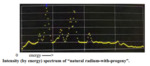
Radioactive Bioaccumulation in Clams along the Hanford Reach
Hanford Action of Oregon and Norm Buske
Public concern drives clean-up of the Hanford Site in eastern Washington state, especially where radioactive groundwater seeps from the site into the river. In September 2004, The RadioActivist Campaign (TRAC) collected riverbed water and Asian clams from six locations along the Hanford Reach:
• Vernita (upstream background location, by a shoreline spring)
• N-Springs (which drain old N-Reactor waste disposal trenches)
• D-Island (sampled upstream of the D- and DR-Reactor discharge pipes)
• F (sampled near a spring below F-Reactor)
• Hanford Townsite (sampled at a spring fed from central Hanford)
• 300 Area (sampled near a spring at “Location 9”)
Asian clams (Corbicula sp.) are a recognized indicator of Hanford’s biological impact on the Columbia River ecology. TRAC collected about 200 clams from each location, and shucked these clams into a flesh fraction and a shell fraction. From each of the 6 locations, TRAC analyzed one clam flesh sample, one shell sample, and one riverbed water sample, for both short- and long-lived radioactivity.
Based on these analyses, the present study finds that the biological effects of strontium-90 seeping from N-Springs into the river have been under-reported in official monitoring. This finding raises concern for the adequacy of official Hanford Site monitoring.This study confirms official reports that uranium seeping from Hanford’s 300 Area contaminates nearby aquatic biota.
This research was completed money allocated during Round 1 of the Citizens’ Monitoring and Technical Assessment Fund (MTA Fund). Clark University was named conservator of these works.
If you have any questions or concerns please contact us at [email protected]
-
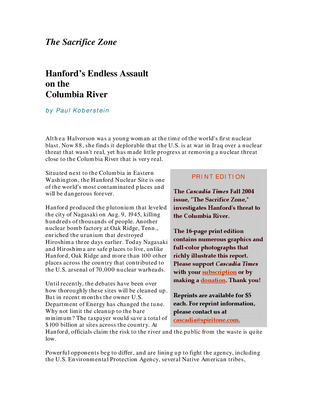
The Sacrifice Zone: Hanford's Endless Assault on the Columbia River
Hanford Action of Oregon and Paul Koverstein
Printed in the Fall 2004 issue of the Cascadia Times.
Althea Halvorson was a young woman at the time of the world's first nuclear blast. Now 88, she finds it deplorable that the U.S. is at war in Iraq over a nuclear threat that wasn't real, yet has made little progress at removing a nuclear threat close to the Columbia River that is very real.
Situated next to the Columbia in Eastern Washington, the Hanford Nuclear Site is one of the world's most contaminated places and will be dangerous forever. Hanford produced the plutonium that leveled the city of Nagasaki on Aug. 9, 1945, killing hundreds of thousands of people.
Another nuclear bomb factory at Oak Ridge, Tenn., enriched the uranium that destroyed Hiroshima three days earlier. Today Nagasaki and Hiroshima are safe places to live, unlike Hanford, Oak Ridge and more than 100 other places across the country that contributed to the U.S. arsenal of 70,000 nuclear warheads.
This research was completed money allocated during Round 3 of the Citizens’ Monitoring and Technical Assessment Fund (MTA Fund). Clark University was named conservator of these works.
If you have any questions or concerns please contact us at [email protected]
-
Report of Hanford Site Access
Hanford Action of Oregon and Norm Buske
Nine rooted vegetation samples were collected from Hanford on November 12, 2002, under a Hanford Site access agreement. Each of the 6 samples tested positive for at least one artificial radionuclide, probably of Hanford origin. These positive results show upward migration to the land surface vis deep-rooted plants that introduce the radioactivity into surface biota.
Hanford's strategy of cleaning up the topmost 15 feet of soil on the site is thus seen to rely on preclusion of deep-rooted, arid land vegetation. The "irrigated agriculture" and "rural residential" land use scenarios envision shallow-rooted plants that would not take buried waste up to the land surface. These positive results suggest that realistic land use scenarios should assume deep-rooted, arid land plants.
Present use of the 300-Area is essentially industrial. The main operator, DOE/RL, prevents uptake of buried radioactivity through deep-rooted vegetation by covering the ground with gravel and intensive application of herbicides. The real time fallibility of such institutional controls is seen by the feasibility of collecting deep-rooted plants from pre-selected locations in the 300-Area. While Hanford clean-up and future site management strategies take some account of the surprisingly short utility of institutional controls, the important lesson here is that institutional controls tend to be ineffective even from the outset.
The combination of clean-up strategies that do not account for unfavorable conditions that can be expected together with reliance on institutional controls that won't control bodes ill for safety and environmental quality in the future of Hanford site.
This research was completed money allocated during Round 3 of the Citizens’ Monitoring and Technical Assessment Fund (MTA Fund). Clark University was named conservator of these works.
If you have any questions or concerns please contact us at [email protected]